23 October, 2026 | 4:21 AM


Playing with children’s lives?
23-08-2026 12:00:00 AM

Centralized grocery procurement raises quality and accountability concerns
metro india news I hyderabad
In a move intended to streamline supplies and cut costs, the state government has shifted the procurement of essential provisions for nearly 3,800 residential schools and colleges to a centralized Project Monitoring Unit (PMU). The system covers approximately 7.5 lakh students from Scheduled Castes, Scheduled Tribes, Backward Classes, minorities, and Kasturba Gandhi Balika Vidyalayas (KGBVs). Still, questions are mounting over whether the pursuit of lower prices is compromising the quality and reliability of food reaching some of the state’s most vulnerable children.For years, the procurement of groceries such as turdal (pigeon pea), sugar, tamarind and other staples was handled by 33 District Purchase Committees (DPCs). Each committee was headed by the respective Additional Collector and included the District Medical and Health Officer, District Education Officer, and social welfare officials.
These local bodies routinely approved rates that reflected prevailing market conditions and gave preference to local small and medium enterprises (SMEs) and micro, small and medium enterprises (MSMEs). Turdal, for instance, was typically procured at around Rs 170 per kg. Under the new centralized model, the PMU floated tenders that produced significantly lower quotes. Turdal rates fell to Rs 140 per kg and were further negotiated down to approximately Rs 130 per kg. Sugar was finalized at Rs 50 per kg against a prevailing market rate of around Rs 60 per kg. On paper, the savings appear substantial and fiscally responsible. The supply contract, however, has been awarded to NAFED (National Agricultural Cooperative Marketing Federation of India), referred to in official circles as NAACOF in some documents—a central government agency.
Sources familiar with the matter point out that both NAFED and Kendriya Bhandar were penalized by the Civil Supplies Department in the same year for non-performance. A government order directed the recovery of more than Rs 65 crore from the agencies for failing to meet supply obligations. This has triggered sharp questions about inter-departmental coordination. Officials wonder how one wing of the government could award a major contract for feeding hundreds of thousands of residential school students to agencies that another wing had only recently found deficient and ordered to repay large sums. The lack of apparent communication between the Civil Supplies Department and the PMU has fueled concerns that institutional memory and performance records are not being adequately shared.
Critics argue that while lower rates are welcome, the real test lies in consistent quality, timely delivery, and nutritional standards. Residential schools house children who often come from economically disadvantaged backgrounds and depend entirely on institutional meals for their daily nutrition. Any shortfall in quality—whether in the purity of pulses, the moisture content of sugar, or the freshness of other commodities—can have direct consequences for the health of students. Past experiences with centralized agencies in public distribution systems have sometimes revealed gaps between quoted rates and actual delivered quality.
Local vendors and MSME associations have also expressed unease. The earlier district-level system, they say, supported regional economies and allowed closer monitoring by officials who understood local market dynamics and supply chains. Centralization risks sidelining these smaller players and concentrating supply in the hands of large agencies whose past performance has drawn official censure. 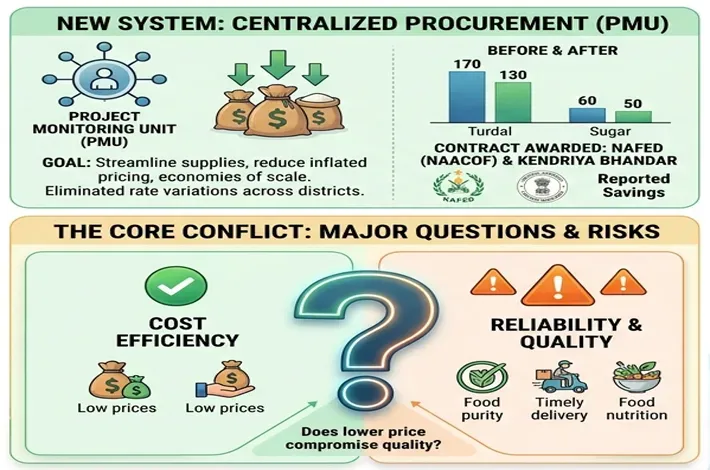
Government sources defend the PMU model as a necessary reform aimed at eliminating rate variations across districts, reducing opportunities for inflated pricing, and achieving economies of scale. They note that the tender process was transparent and that the negotiated rates represent genuine savings for the public exchequer. Proponents argue that strong monitoring mechanisms and quality checks can ensure that lower prices do not translate into inferior supplies.Nevertheless, the juxtaposition of dramatic rate reductions with the selection of previously penalized agencies has created an atmosphere of skepticism.
Education and social welfare activists have called for greater transparency in the tender evaluation process, public disclosure of the quality parameters specified in the contracts, and independent third-party testing of consignments arriving at schools. They also urge the government to clarify what safeguards have been built into the agreements to prevent the kind of non-performance that earlier triggered multi-crore recoveries. The scale of the operation is significant. Feeding 7.5 lakh students across thousands of institutions requires a robust logistics network capable of reaching remote ashram schools and residential complexes on schedule. Any disruption—whether due to delayed payments, quality disputes, or capacity constraints of the supplier—could leave kitchens short of essential ingredients. In such settings, even temporary shortages can affect attendance, concentration, and overall well-being of children.
Observers note that centralized procurement is not inherently flawed; several states have successfully adopted similar models when accompanied by rigorous quality assurance, real-time tracking, and accountability mechanisms. The current controversy centers less on the principle of centralization and more on the specific choice of supplier and the apparent disconnect between departments handling related responsibilities. As the academic year progresses, the effectiveness of the new arrangement will be measured not by the rates quoted in tender documents but by the quality of meals served in dining halls across the state.
For the children who depend on these schools for both education and nutrition, the difference between a rate of Rs 170 and Rs 130 per kg of turdal matters far less than whether the dal that reaches their plates is wholesome, consistent, and delivered without interruption.The government faces a clear test: to demonstrate that cost efficiency and reliable supply to welfare institutions can coexist. Until transparent monitoring reports and independent quality assessments become available, doubts about the safety and adequacy of provisions for these 7.5 lakh students are likely to persist.