28 July, 2026 | 1:31 PM


India Inc’s ageing titans trigger succession anxiety?
18-05-2026 12:00:00 AM
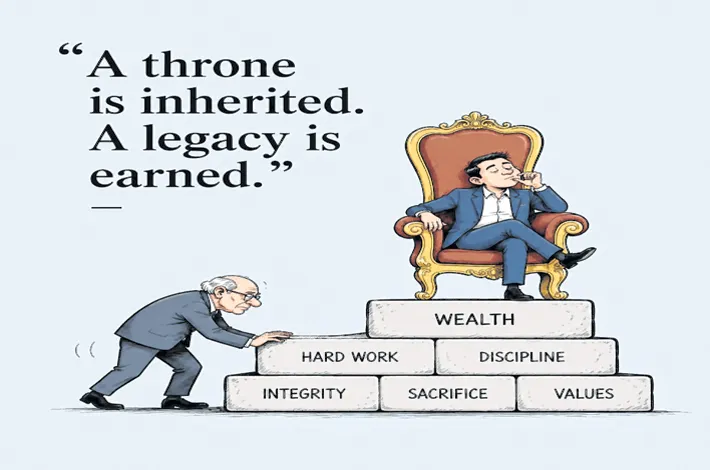
THE BURDEN OF INHERITANCE| Boardrooms increasingly fear whether inherited privilege can preserve institutions built through sacrifice, discipline and public trust; emotional disconnects threaten, philanthropy and responsible nation-building
Palazhi Ashok Kumar MUMBAI
Across Mumbai’s glittering skyline, where billion-rupee towers pierce monsoon clouds and imported supercars glide past exhausted commuters, a silent but deeply consequential transition is unfolding inside the heart of India’s economic empire.
Beneath the optimism surrounding IPOs, expanding conglomerates and the grand promises of “Viksit Bharat”, an uneasy national question now echoes quietly through ministries, markets and middle-class homes alike: who will guide Corporate India when its ageing patriarchs finally step aside?
India’s great industrial generation is entering twilight.
“Building wealth is easier than building worthy successors,” a worried father and chairman of one of India’s leading conglomerates — himself the parent of four sons and two daughters involved in the family business — told this writer on Sunday on condition of anonymity.
His concern increasingly resonates across India Inc, where succession planning has quietly become one of the nation’s most delicate corporate anxieties.
‘Empires built through scarcity’
It also partly explains why several influential business families and tightly controlled mega enterprises remain hesitant about wider stock-market exposure. Public listing demands transparency, institutional discipline, shareholder scrutiny and governance standards that many promoters find uncomfortable during fragile generational transitions.
From the institution-building vision of J. R. D. Tata and the humane legacy of Ratan Tata at Tata Group to the fearless entrepreneurial rise of Dhirubhai Ambani at Reliance Industries, modern India was shaped by leaders who understood scarcity, uncertainty and sacrifice.
The industrial foresight of Ghanshyam Das Birla and later generations at Aditya Birla Group, the grounded philosophy of Keshub Mahindra at Mahindra Group, and the disciplined professionalism of N. R. Narayana Murthy at Infosys and Azim Premji at Wipro emerged from an India far removed from instant privilege and digital extravagance.
These outstanding leaders had witnessed shortages, licence-era anxieties, social uncertainty and fragile markets. Many constructed enterprises brick by brick, often risking everything they possessed. Wealth, for them, was not merely consumption. It was duty.
Privilege without perspective
Last week, Sunil Bharti Mittal openly acknowledged the need for a structured, decade-long transition roadmap within Bharti Enterprises. His remarks reflected realism, maturity, and a quiet sense of urgency. A salute to Mr. Mittal for his clarity and foresight.
India undoubtedly possesses millions of sincere young entrepreneurs and innovators capable of building a stronger future. Yet another culture is also spreading silently — one shaped by entitlement, impatience and emotional detachment from ordinary realities. One privileged youth casually spends ₹50,000 at a fashionable restaurant while another struggles for a roadside meal.
Honest employees remain silent before insecure superiors intoxicated by inherited authority. Aggression is mistaken for efficiency; arrogance for leadership. As Warren Buffett once observed, “Someone is sitting in the shade today because someone planted a tree a long time ago.” India’s future custodians must remember: the shade they inherit was planted through sacrifice, humility and restraint — not entitlement alone. For nations decline quietly when power forgets compassion, success loses restraint, and leadership stops listening to the people beneath the skyscrapers.
UHNW individual population
India’s ultra-high-net-worth individual (UHNW) population has surged sharply over the past five years, reflecting strong wealth creation across technology, industrials and capital markets, according to the 20th edition of Knight Frank’s The Wealth Report. India’s population of individuals with assets above $30 mn rose 63% between 2021 and 2026 to nearly 20,000, and is projected to grow another 27% by 2031. The report said Mumbai remains the country’s luxury property hub, recording 56 new-build home sales in the $5 mn-plus category in 2025, driven by rising demand for premium homes and lifestyle upgrades among affluent buyers.