8 July, 2026 | 6:48 PM


Hyd to go industry-free in 5 years: CM
19-02-2026 12:00:00 AM
metro india news I hyderabad
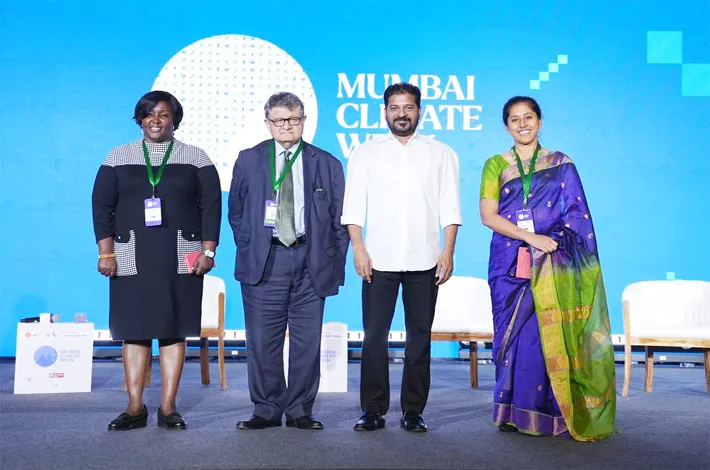
Telangana Chief Minister A. Revanth Reddy has announced a bold five-year plan to gradually move industries out of urban Hyderabad as part of the State’s roadmap to transform the capital into a Net-Zero city by 2034. He revealed that the government will soon undertake a comprehensive carbon footprint audit, making Hyderabad one of India’s first cities to initiate such a large-scale climate accountability exercise.
Addressing the Mumbai Climate Week 2026 conference on Wednesday, the Chief Minister outlined Telangana’s integrated strategy balancing rapid economic growth with environmental sustainability. He stated that within the next five years, Hyderabad’s core urban region will have minimal industrial presence, with manufacturing units being shifted to designated peri-urban green zones.
Highlighting sustainability initiatives, Revanth Reddy detailed the rejuvenation of the Musi River, restoration of lakes, strengthening of water grids, and expansion of clean energy infrastructure. He also announced the formation of HYDRAA — described as India’s first dedicated environmental protection police force — to safeguard urban ecosystems.
In a major push toward green mobility, the Chief Minister said taxes on electric vehicles have been abolished in Hyderabad, leading to a surge in EV adoption. Discussions are underway with EV manufacturers for local production investments. Over 2 lakh autorickshaws are being retrofitted with greener alternatives, while more than 3,500 RTC buses are being replaced with electric buses.
The Hyderabad Metro network will expand from 71 km to over 200 km to reduce vehicular emissions.
Calling energy the “real currency” of any economy, he noted that Telangana’s average daily power consumption stands at 16,610 MW, with peak demand projected to cross 34,000 MW by 2034 as the State aims for a $1 trillion economy. Nearly 25% of Telangana’s energy already comes from green sources.
Reiterating the State’s long-term vision, the Chief Minister said Telangana seeks to grow from a $200 billion economy to $1 trillion by 2034 and $3 trillion by 2047. The development strategy is structured around three zones — CURE (Core Urban Region Economy), PURE (Planned Urban & Rural Economy), and RARE (Rural & Agricultural Region Economy). The PURE zone between the Outer Ring Road and Regional Ring Road is being developed as a major green-powered manufacturing hub, positioning Telangana as a strong “China +1” alternative.