3 May, 2026 | 10:27 PM


Dr M V Soundararajan passes away @ 90
28-02-2026 12:00:00 AM
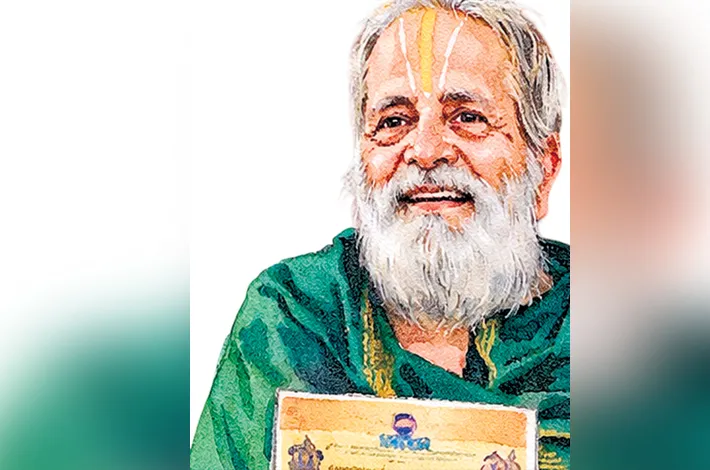
Former chief priest of Chilkur Balaji Temple, Soundararajan leaves behind a legacy of scholarly excellence, compassionate administration, and unwavering advocacy for religious autonomy
Dr. M.V. Soundararajan, the esteemed academician, former registrar of Osmania University, and pioneering figure in the Hindu temples protection movement, passed away on Friday due to age-related ailments. He was 90 years old. As the hereditary trustee and former chief priest of the iconic Chilkur Balaji Temple, Soundararajan leaves behind a legacy of scholarly excellence, compassionate administration, and unwavering advocacy for religious autonomy.
His son, Dr. C.S. Rangarajan, the current chief priest of the temple, confirmed the news, stating that his father had been battling prolonged illness but remained dedicated to his causes until the end.
Born in 1936, Soundararajan was a multifaceted personality who seamlessly blended academia with spiritual service. He began his career as a professor of commerce at Osmania University, where he quickly rose through the ranks. Serving as the controller of examinations, chief warden, and eventually registrar, he was known for his student-centric approach. Colleagues and former students recall him handling administrative matters not with bureaucratic rigidity but as a "loving parent," ensuring the welfare and well-being of thousands under his care. His tenure at the university spanned decades, during which he mentored countless scholars, earning a reputation as a philosopher, guide, and teacher. Notably, he was popular for his distinctive turban, styled akin to that of former President Sarvepalli Radhakrishnan, symbolizing his deep respect for Indian intellectual traditions.
Soundararajan's contributions extended far beyond academia into the realm of religious preservation. As the founder chief priest of the ancient Sri Balaji Temple in Chilkur, located on the banks of Osman Sagar in Rangareddy District, he transformed the 500-year-old shrine into a global pilgrimage site. Built during the era of Madanna and Akkanna, uncles of Bhakta Ramadasu, the temple gained fame under his stewardship as the "Visa Balaji Temple," where devotees seek blessings for visa approvals and immigration success. Attracting over 100,000 visitors weekly, it became a beacon of faith without commercial trappings—no hundi for donations and no VIP privileges, setting it apart from many other temples.
His family's commitment to ethics was unwavering. Soundararajan and his kin managed the temple strictly in line with its ancient principles, rejecting any compromise on values. He meticulously groomed his children, particularly Dr. C.S. Rangarajan, to uphold the lineage. Rangarajan, a biomedical engineer turned priest with a law degree, joined the service in 2003 at age 35, assisting his father in temple operations and advocacy.
Together, they published the trilingual monthly journal "VAK," voicing concerns on temple issues, and initiated programs like promoting handlooms on Saturdays to support weavers. Soundararajan's most enduring legacy lies in his legal crusades to safeguard Hindu temples from government interference. As convenor of the Temples Protection Movement, founded in the 1980s, he fought relentless battles in India's courts, including the Supreme Court, for decades. In 2002, he successfully opposed a government bid to take over Chilkur Balaji, securing its independence—a rare feat shared by only a few temples like Jalaram in Gujarat.
He intervened in landmark cases, such as the 2020 Padmanabhaswamy Temple verdict, where the Supreme Court upheld the Travancore royal family's rights, hailing it as a "victory for dharma." He also protested the 2018 Sabarimala ruling on women's entry, appealing to the central government to protect deities' rights. Additionally, he sued the Tirumala Tirupati Devasthanams (TTD) in 2016 for unpaid dues to Telangana's endowments, claiming 7% of TTD's annual income—over Rs 1,000 crore—as per historical agreements. His writings, including "Legislation for Temples Destruction" and his son's LLM thesis "Govt Rules Hindu Temples," became key references in the movement.
Even in his later years, Soundararajan remained active. In 2025, following an attack on his son by alleged Ikshwaku descendants demanding association, he issued a strong condemnation, emphasizing true Rama Rajya. His efforts also included prayers for global figures like the Dalai Lama and appeals to Prime Minister Narendra Modi on temple reforms.
Tributes poured in from devotees, scholars, and leaders. Osmania University Vice-Chancellor Prof. D. Ravinder described him as an "irreplaceable pillar of education and ethics." Temple visitors mourned the loss of a "guardian of dharma." Soundararajan is survived by his family, including Dr. Rangarajan, who vows to continue his father's work. In an era of commercialization, Dr. Soundararajan's life exemplified integrity, blending intellect with devotion. His passing marks the end of an era, but his impact on education, temple autonomy, and Hindu heritage endures.