9 July, 2026 | 3:40 AM


100-day civic action plan to start Feb 23
19-02-2026 12:00:00 AM
Metro India News | Hyderabad
The Telangana government has finalized a comprehensive 100-day action plan to improve civic services across three key urban corporations, with field-level implementation set to begin on February 23. On Wednesday, Special Chief Secretary Jayesh Ranjan approved the plan and directed the Greater Hyderabad Municipal Corporation (GHMC), Cyberabad Municipal Corporation (CMC), and Malkajgiri Municipal Corporation (MMC) to prepare for the launch and submit provisional schedules for execution.
The initiative is aimed at bringing governance closer to citizens and ensuring more efficient delivery of public services in the newly merged municipal areas. Officials said the plan will focus on three core objectives: enhancing public participation, improving the quality and timeliness of municipal services, and implementing institutional reforms to strengthen accountability.
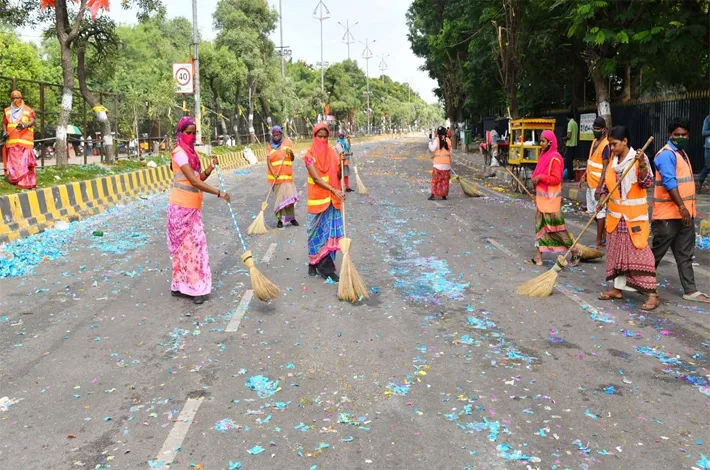
Under the 100-day plan, municipal corporations are expected to prioritize sanitation drives, including regular garbage collection and street cleaning, as well as addressing long-pending complaints related to water supply, drainage, and public health. Road repairs and maintenance of public infrastructure such as streetlights, parks, and community halls will also receive special attention.
Transparency and responsiveness will be key pillars of the initiative. Daily monitoring of activities will be conducted to ensure that work progresses as per schedule, while public feedback mechanisms will be strengthened to involve citizens in decision-making and service oversight. The government also intends to streamline internal administration by identifying bottlenecks in service delivery and improving coordination among various departments.
With elections likely in the three corporations in the near future, the government sees the action plan as a way to visibly enhance civic governance and demonstrate accountability. Officials expect that improved service delivery, faster grievance redressal, and better urban management will have a tangible impact on residents’ daily lives.
By emphasizing operational efficiency, citizen engagement, and institutional reforms, the 100-day action plan is intended to set a benchmark for municipal governance. The government hopes that the initiative will not only address immediate issues but also lay the foundation for sustained improvement in civic administration across Telangana’s core urban areas.
GHMC plans new advertising policy
The Greater Hyderabad Municipal Corporation (GHMC) is in the final stages of drafting a new advertising policy after extensive deliberations, including a review meeting with the Chief Minister. Earlier, GHMC allowed commercial advertisements on hoardings and unipoles across the city, but a series of accidents prompted restrictions. Following this, advertising agencies approached the courts, leading GHMC to rethink its framework.
The proposed policy aims to allow hoardings and unipoles only in selected areas with no history of accidents, including flyovers and other public spaces. Officials are finalizing guidelines, which will be presented to the cabinet for approval after incorporating government suggestions. The policy will specify locations, set limits on the number of hoardings and unipoles, and reserve ten percent of spaces for government scheme promotions. The remaining spaces will be offered through online auctions. Some installations will follow a public-private partnership (PPP) model, where private entities can manage them for a fixed period before ownership reverts to GHMC.
The policy aims to generate revenue without financial burden on the corporation, focusing on high-visibility areas such as traffic signals, flyovers, and private buildings. GHMC will also ensure proper maintenance and transparent allocation, following directives from Chief Minister Revanth Reddy.
Meanwhile, GHMC plans to remove illegal hoardings in the 27 merged urban local bodies. Commissioner R.V. Karnan noted that agencies had installed double the permitted number, earning illegal profits. Locations prone to accidents, including traffic signals, intersections, and main roads, have been identified for prompt action. The new policy seeks to balance public safety, revenue generation, and transparent management of city advertising, taking cues from international practices like those in Canada.