30 September, 2026 | 3:21 AM


Ayushmann: Stardom is no longer an exclusive club
30-09-2026 12:00:00 AM
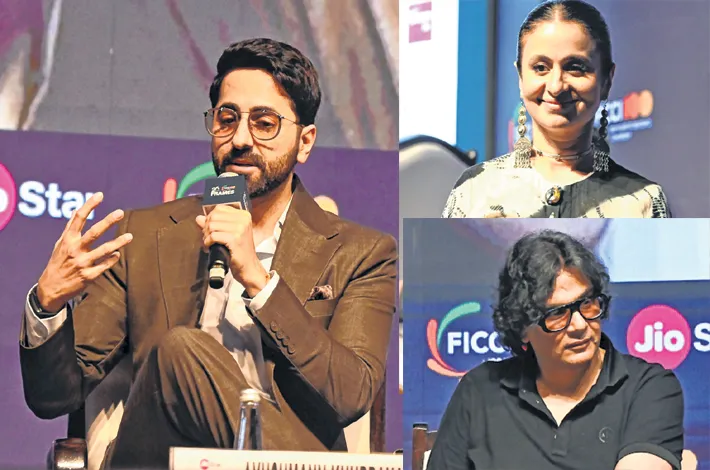
FICCI Frames 2026 is being held on September 29 and 30, with the theme ‘India’s Media Moment: Creating Value in an Age of Infinite Content’
* I’ve always believed that one story, one good story, can start a conversation, and one conversation can create change
— Ayushmann Khurrana
Kabir Singh Bhandari :
During a panel discussion titled ‘Cinema at Crossroads - The Rules of the Big Screen’, actor Ayushmann Khurrana, who is also the FICCI FRAMES Ambassador, opened up on theatrical cinema navigating changing audience preferences, evolving economics and the rise of streaming, basically, how the rules of the big screen are being rewritten. The Free Press
Journal was present at the event.
“I’ve always believed that one story, one good story, can start a conversation, and one conversation can create change. I think if the story is authentic, it will find an audience. And as far as stardom is concerned, it’s relative. It used to be an exclusive club before, but not anymore. Right now, the script is the star, and stardom is relative. It’s never one size fits all, as you always come across different kinds of people. I, for example, like interacting with people because I come from the background of being an RJ. But there may be another star who may be completely reticent, will not talk to the media, and isn’t approachable,” Khurrana said.
Rasika Dugal on balancing authenticity & accessibility
Rasika Dugal, riding high on the success of Mirzapur: The Movie, spoke on the panel, The New Mainstream: Why Rooted Stories Are Winning Audiences. The panel was about how in an era of abundant content, audiences are increasingly gravitating towards hyperlocalnarratives deeply rooted in their culture, and communities are finding audiences farbeyond their place of origin.
“The tough choice always is authenticity versus accessibility, and that’s one thing that we constantly struggle with as writers, directors and actors. For example, I shot a film in Kashmir called Hamid (2018), and I struggled for a long time to understand how to speak in the film, because the film was in Hindi, which is not the language of that region. So these are difficult creative choices when you’re trying to be as authentic to the material as possible. So you’ve already made one creative decision that if you’re going to keep it in Hindi, then you’re already sort of making it more accessible to an audience, but compromising on the authenticity of it anyway. Or by casting somebody who is not actually Kashmiri, you’re already compromising,” Rasika said.
Mukesh Chhabra on the changing casting landscape
The same panel had the current badshah of casting, Mukesh Chhabra, who spoke on the profession of casting. “A casting director can only work if you have a great story. My target is to cast real people and real talent so that we can relate to that talent. Thank God there are so many talented people in the country, because of which I don’t have to run after popular stars,” Mukesh said.
The moment that probably stayed the most with the audience was probably what Mukesh mentioned towards the end, about how OTT seems to be playing mostly to the adults, while for kids there are hardly any shows. “Even Single Papa is about the papa, not about the kids,” he said.