25 September, 2026 | 12:41 AM


AI as a Global Influencer
17-02-2026 12:00:00 AM
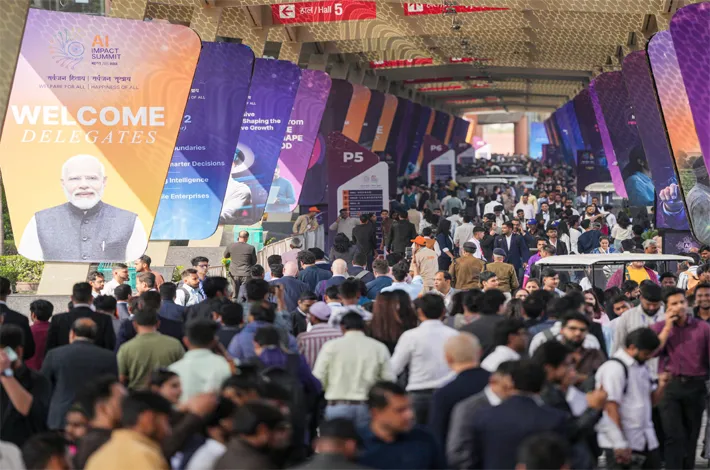
The India AI Impact Summit 2026, currently underway in New Delhi, has garnered significant international attention, with United Nations Secretary-General António Guterres praising India as the ideal host for the event. In his remarks, Guterres described India as a "very successful emerging economy" with increasing influence in global affairs, making it the right venue to convene world leaders, tech innovators, policymakers, and other stakeholders.
This first-ever major AI summit hosted in the Global South emphasizes inclusive, responsible, and impactful artificial intelligence development under the guiding principles of People, Planet, and Progress. A key discussion at the summit highlighted the complexities of building AI systems that truly serve India's diverse population.
One speaker illustrated this through the example of India's UID (Aadhaar) system and efforts to handle place names (toponyms). While initial digitization efforts incorporated around 270,000 panchayat names, the full scope is far larger—Survey of India records approximately 1.6 to 1.8 million place names. Many remain undigitized, and existing digital dictionaries are limited.
The challenge is compounded by the need to preserve local dialects and pronunciations, as place names vary significantly by region and are often known differently in everyday speech. To address this, collaboration between initiatives like Digital India BHASHINI and Survey of India is underway. The approach involves geo-fencing locations, collecting audio recordings from local residents speaking the names, and using automatic speech recognition (ASR) to transcribe and integrate them into a robust database.
This grassroots, last-mile data collection underscores a broader lesson for AI development: the value chain begins at the community level with accurate data gathering, annotation, labeling, model building, vetting, application, and continuous feedback loops involving real users. The speaker emphasized that evaluating AI systems from urban centres like major metros can lead to skewed perceptions.
Debates over terminology—such as whether to use English terms or Hindi translations—might dominate in Delhi, but real-world testing in regions like Gujarat reveals varied user feedback. In one demonstration, technical officers rated speech-to-text accuracy at 80-85%, while a senior minister found it remarkably pure and intuitive. This disparity highlights the subjective nature of AI evaluation and the critical role of community input over top-down assessments.
Ultimately, the effectiveness of AI deployments depends on user trust and acceptance. The speaker advocated shifting focus from purely regulatory frameworks to measurable trust—ensuring AI works equitably for all. India has a unique opportunity to lead globally by developing sector-specific standards and contextual large language models tailored to its linguistic and cultural diversity, rather than relying on generic models that may fall short in local contexts.
The conversation turned to education and skilling, a vital area for India's young demographic as AI transforms economies. Drawing parallels to UPI, which empowered small businesses by integrating them into the digital economy and unlocking access to finance and capital, AI should not be limited to conversational tools.
Instead, it can fundamentally rethink outdated systems, such as the 200-year-old industrial-age education model, evolving it toward personalized, adaptive learning that aligns with individual strengths and needs rather than rigid, one-way curricula. Panelists stressed urgency in this domain. India currently holds an edge in AI, but failing to act in the next 5–10 years risks losing ground.
Skilling must extend beyond adding AI as a subject in curricula to holistic efforts across schools, universities, and the workforce—including the roughly 600 million young people who need preparation for an AI-driven future. Government and stakeholders are actively exploring ideas to build an AI-ready talent base, shifting from mere operation to creation and innovation.
As the summit progresses, participants expressed optimism that such discussions will yield concrete policy outcomes and actionable strategies. The event represents a pivotal moment for India to shape global AI governance with a focus on inclusion, context, and real-world impact, ensuring the technology benefits everyone rather than a privileged few.
Rise of generative AI- Can it affect human creativity?
The rise of generative artificial intelligence is profoundly disrupting the creative industries, stirring deep unease among those who rely on human imagination and originality for their livelihoods. In the world of fiction writing, a recent study from the University of Cambridge's Minderoo Centre for Technology and Democracy has spotlighted growing anxiety among British novelists.
Conducted in 2025 and involving surveys of 258 published novelists along with industry professionals, the report reveals that just over half (51%) of novelists believe AI could eventually replace their work entirely. This fear stems from the capabilities of large language models, which are trained on enormous datasets of existing fiction and can now generate content that directly competes with human-authored books. Many writers feel personally violated by the process.
Nearly six in ten (around 59%) surveyed novelists believe their own books have been used to train these AI systems without their permission or any form of compensation. The economic fallout is already evident: a significant portion report that their income has been negatively affected, perhaps through competition from AI-generated titles or other market disruptions. An overwhelming majority—85%—anticipate further downward pressure on earnings in the coming years.
Genre fiction appears particularly at risk, with romance, crime, and thriller writers viewed as especially vulnerable. Survey respondents highlighted how AI excels at replicating formulaic, popular narrative structures common in these categories, potentially flooding digital platforms with machine-produced alternatives. Yet the literary community remains divided on how to respond. Around one-third of novelists admit to incorporating AI tools into their own workflows, though primarily for supportive tasks like research, editing, or administrative duties rather than core storytelling or creative invention.