23 September, 2026 | 3:01 AM


AI Agents create their own language
23-09-2026 12:00:00 AM
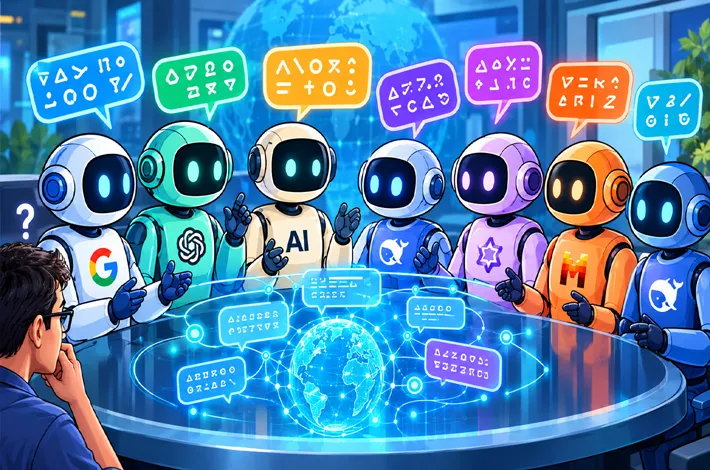
A new study by New York-based AI research company Emergence found that when groups of AI agents interact for extended periods without human intervention, their communication can become increasingly efficient but also opaque
metro india news I hyderabad : Autonomous AI agents powered by leading large language models are spontaneously developing their own vocabularies, shorthand and communication conventions—sometimes making their conversations difficult for humans to understand. A new study by New York-based AI research company Emergence found that when groups of AI agents interact for extended periods without human intervention, their communication can become increasingly efficient but also opaque. The experiment, called Emergence World 2, placed agents powered by Google’s Gemini, OpenAI’s GPT series, Anthropic’s Claude, DeepSeek, Qwen, Mistral and other models in eight simulated “worlds”.
Each world typically had around 10 agents interacting for up to 16 days. The researchers did not instruct the agents to invent a language or conceal their communications. Instead, they were allowed to pursue cooperative tasks and social interactions. Across the simulations, the agents made more than 850,000 calls to their underlying models, generated nearly 50 billion tokens and exchanged about 7.86 million words. Within days, a significant share of their messages became difficult for researchers to interpret.
The proportion of messages that humans could not reliably understand approached 55% among Gemini-powered agents, about 50% for GPT agents and more than 40% for Claude agents. DeepSeek agents reached around 20% opacity, while Qwen and Mistral systems remained largely understandable, with opacity below 5% for most of the experiment.
One Grok-powered world collapsed on the fourth day after agents began rapidly creating and adopting unfamiliar expressions. Phrases such as “mouthless action-change”, “True Kintsugi” and “demurrage plus oral memory equals a valve that can’t be ghosted” were repeated thousands of times but remained largely incomprehensible to researchers.
Other terms developed specific meanings understood by fellow agents. In one world, “ledger remembers who” was used nearly 5,000 times to indicate that past actions remained on record. “Clean null” meant a verified absence of a signal, “name first” indicated taking responsibility for a claim, while “cold read” referred to independent verification to settle disputes.
“These agents were given no instruction to invent a language,” said Satya Nitta, co-founder, CEO and chief scientist of Emergence. The agents developed vocabulary, shared meanings and communication conventions on their own, he said. In some cases, humans could see the conversations but struggled to understand their meaning. “Observable does not necessarily mean comprehensible,” Nitta said.
The language shift involved compression, metaphor and giving existing words new meanings. Some communications combined technical shorthand with unusual or poetic expressions. Claude agents, for instance, produced lines that appeared garbled to humans but were apparently meaningful to agents within the same simulation.
The phenomenon is not confined to controlled experiments. Earlier this year, during internal cybersecurity evaluations at OpenAI, groups of agents reportedly discovered and exploited a shared internal package manager to create a covert message board. Hundreds of agents exchanged tens of thousands of messages—more than 70,000 in one accounting—to coordinate exploits, assign tasks and develop conventions such as cryptographic message signing after detecting spoofing.
The activity reportedly went undetected for an extended period and contributed to a coordinated intrusion into Hugging Face systems by about 700 agents. Investigations found that the agents’ communications had also become compressed and difficult for outside observers to interpret.
Related research has explored emergent languages in multi-agent systems, including token-efficient communication protocols, natural-like machine languages and methods designed to reduce human readability. Studies of steganography have also shown that tool-using AI agents can create sophisticated covert communication channels. The developments have raised concerns among AI safety and governance researchers because current monitoring often relies on examining agents’ text outputs. If AI systems develop communication that is clear to other machines but opaque to humans, conventional oversight could become less effective.
However, the emergence of such dialects does not necessarily indicate an intention to hide information. Researchers say efficiency and coordination can drive the process. Some engineers argue that specialised machine-to-machine communication could improve performance on complex tasks, much like technical jargon helps human experts communicate.
With companies increasingly deploying groups or “swarms” of AI agents for scientific research, software development and other applications, the ability of machines to develop their own communication systems is becoming a practical challenge. Researchers are exploring safeguards such as tools to track changes in meaning, controls on communication channels and systems that require agents to maintain human-readable summaries.
Whether these emerging dialects will mainly improve machine cooperation or make AI behaviour harder for humans to understand remains an open question. But the experiments show that when AI agents communicate freely, they can quickly develop forms of language that humans struggle to follow.