25 September, 2026 | 1:07 AM


SIR and Citizens Trust
25-09-2026 12:00:00 AM
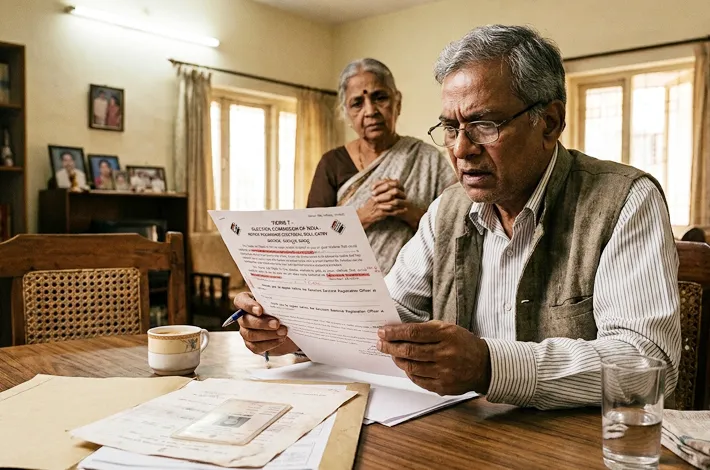
What happens when an ordinary citizen receives a notice questioning the very basis on which his or her name appears on the electoral roll? For many, it is not merely an administrative inconvenience. It can become a deeply unsettling encounter with the machinery of the State.
That concern surfaced prominently during a recent meeting of the Friday Evening Team (FETE) at the Press Club Hyderabad, where the Special Intensive Revision (SIR) of electoral rolls became the focus of an extended discussion. Participants examined the increasingly complex notices being issued through Booth Level Officers (BLOs), and questioned whether electoral-roll verification can remain fair and transparent when citizens are asked to establish links with earlier electoral records through procedures that may not always be readily understandable.
The debate has acquired greater significance following reports of differences within the three-member Election Commission of India (ECI). According to an investigation by The Indian Express, Election Commissioners Sukhbir Singh Sandhu and Vivek Joshi recorded objections on at least 14 occasions over a period of 10 months. The reported objections concerned voter additions and deletions, changes to Form 6, appeals relating to electoral rolls and the handling and centralization of voter-data systems. In some instances, the two Commissioners reportedly questioned whether actions had been taken without their knowledge.
The ECI, however, has rejected the suggestion that its decisions lacked the required institutional backing. Officials have maintained that differences and observations during internal deliberations are normal in a multi-member constitutional body and that decisions, including those concerning SIR, were ultimately approved unanimously by all three Commissioners.
That distinction is crucial. An internal objection is not, by itself, proof that a final decision was invalid. Yet the existence of repeated recorded objections inevitably raises questions about transparency, the manner in which decisions are documented and whether citizens are entitled to know how consequential electoral decisions were reached.
Former Chief Election Commissioner S.Y. Quraishi has argued that the Commission should disclose whether decisions were unanimous or taken by majority. He has been quoted as saying that decisions must be unanimous or backed by the majority, while former Election Commissioner Ashok Lavasa has similarly called for greater disclosure of the relevant records.
The issue becomes particularly sensitive at the level of the individual voter. A reported SIR notice tells an elector: “You have not filled in the details related to you or your relative that could establish you or your relative as a registered elector in the electoral rolls prepared during the previous SIR.” The citizen is then directed to appear before the Assistant Electoral Registration Officer.
For a person unfamiliar with electoral procedures, the language of an SIR notice can sound more like a summons than an invitation to clarify a record. When a notice does not clearly state the venue, date or time, or when such information is difficult to locate, the burden falls heavily on citizens to understand and respond to the process.
The ECI’s citizen portal provides facilities to search earlier SIR records and submit documents in response to notices, indicating that the exercise involves formal verification rather than automatic deletion. The Delhi Chief Electoral Officer has also clarified that receiving a notice during the ongoing SIR does not mean an elector’s name will automatically be removed. The electoral authorities have said such notices form part of due diligence intended to ensure accuracy and integrity in voter records.
The deeper concern raised at FETE was therefore not whether electoral rolls should be updated, but how this is done while protecting citizens’ rights. That discussion brought Aldous Huxley’s Brave New World into focus, as a literary warning about systems of classification becoming more powerful than the individuals they classify.
The analogy becomes relevant when data discrepancies determine why one citizen remains within the electoral system while another must undertake additional steps to prove eligibility. A digital democratic database is not inherently neutral: behind every record is a person, and every deletion or exclusion can affect a citizen’s political voice. The concern extends beyond India.
In the United States, states routinely maintain voter rolls by identifying voters who have moved, died or become ineligible, while some exchange interstate data to detect duplicate registrations; Texas participates in such arrangements. Although these systems differ substantially from India’s SIR, both highlight the challenge of maintaining accurate electoral databases without unnecessarily burdening or excluding legitimate voters.
Ultimately, the controversy surrounding SIR is about more than software, forms or BLO notices. It is about institutional accountability and the citizen’s confidence that the right to participate in democracy will not depend upon successfully navigating an opaque bureaucratic maze.

V Jwala Narasimha Rao
Former CPRO to KCR