18 October, 2026 | 12:51 AM


SC: Internet access a fundamental right even for children
18-10-2026 12:00:00 AM
metro india news I new delhi
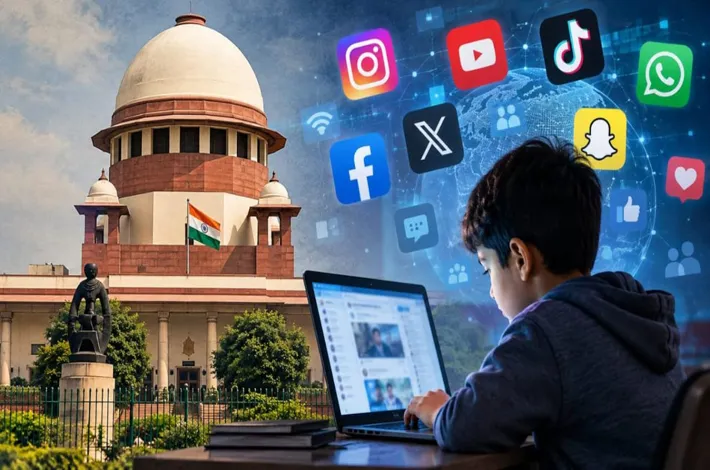
In a landmark ruling with far-reaching implications for digital rights in India, the Supreme Court has declared the right to access and use the internet a fundamental right under Articles 21 and 19(1)(a) of the Constitution. The Court held that this right belongs to every individual, including children of all ages, and that denying it altogether would be absurd.
A bench comprising Justices J.B. Pardiwala and K. Vinod Chandran made the pronouncement on October 15 while issuing extensive directions to combat the circulation of child sexual exploitation and abuse material (CSEAM) on social media platforms and other online spaces. The 137-page order came in the matter of Just Rights for Children Alliance and Anr. v. S. Harish and Ors.
“We have no hesitation in saying that the right to access and use the internet is a fundamental right of every individual under Article 21 read with Article 19(1)(a) of the Constitution. Our children, irrespective of their age enjoy the same rights, and to deny the same altogether would be as absurd as saying children below a certain age do not have a conscience worth protecting or a freedom of speech worth expressing. The safety of our children and their freedom are not at odds with each other. Our children are entitled to both,” the bench observed.
The Court described the internet as a marketplace of ideas, creative expression and information. It underscored that the right to freedom of speech and expression under Article 19(1)(a) has always included the right to know, receive and impart information and ideas. For many children, particularly those in remote areas, the internet often serves as the primary source of learning and information. For children with special needs, it can be the only space to find companionship with others facing similar challenges.
Building on earlier precedents, the judges referred to the 2020 judgment in Anuradha Bhasin v. Union of India, which protected freedom of speech and expression as well as the freedom to carry on trade or business through the internet under Articles 19(1)(a) and 19(1)(g). That ruling had left open the question of whether access to the internet itself constitutes a fundamental right. The bench also relied on the 2025 decision in Pragya Prasun v. Union of India, which recognised the right to digital access as part of the right to life under Article 21. Taking these forward, the Court has now firmly declared the right to access and use the internet a fundamental right that cannot be denied to children.
The Court acknowledged that the internet in its current form is far from safe for children. However, it firmly rejected the idea of blanket age-based restrictions or keeping children entirely offline in the name of protection. Such measures, it said, amount to “unproven measures of proven disproportionality.” No jurisdiction has so far demonstrated that children are safer because of complete bans. The judges warned that blanket restrictions could push children towards unregulated and more dangerous websites. Children who face online enticement or threats might also hesitate to report incidents to parents or trusted adults for fear of being punished for violating access rules.
“To keep the child away from the internet on account of such failures would be to mistake the victim for the problem,” the bench noted, pointing out that the real wrongdoers are those who create, circulate or seek out CSEAM, along with intermediaries that fail to detect and remove it.
While opposing complete denial of access, the Court clarified that proportionate safeguards remain necessary. These could include parental oversight, a dedicated “child mode” for social media accounts, and restrictions on content that is inherently harmful to children. Age-based restrictions of some form are not ruled out, but they must be carefully calibrated rather than absolute.
In addition to the rights pronouncement, the Court issued practical directions aimed at strengthening detection and removal of CSEAM. It directed the Centre to create a national database to help identify and take down sexually explicit visual content depicting minors from digital platforms. The order emphasises faster reporting mechanisms and greater accountability for intermediaries.
The ruling assumes particular significance amid ongoing debates about online safety, internet shutdowns, and proposals to regulate children’s access to social media. By affirming that safety and freedom are not mutually exclusive, the Supreme Court has drawn a clear constitutional line: children cannot be excluded from the digital public sphere simply because the online world carries risks. Instead, the focus must shift to making that space safer while preserving the fundamental rights that belong to every individual, regardless of age.