8 September, 2026 | 1:49 PM


Data center boom-Is the way ahead really smooth?
14-02-2026 12:00:00 AM
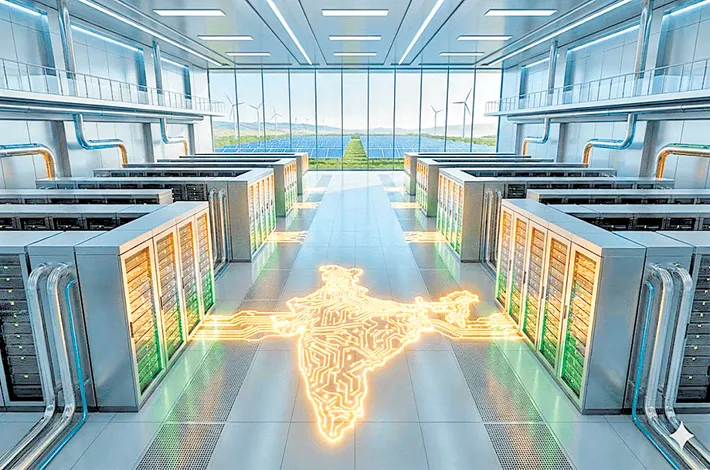
India's data center sector is poised for explosive growth, fueled by surging demand from artificial intelligence (AI), cloud computing, over-the-top (OTT) streaming, and fintech services. Experts describe this as the "next big digital wave," with the sector accelerating rapidly due to supportive government policies and booming digital needs. A key catalyst is the Union Budget 2026 announcement of a long-term tax holiday—extending until 2047—for foreign companies providing cloud services globally using Indian data centers.
This exemption removes tax complications for global tech giants (hyperscalers) that store and process data in India to serve international clients, positioning the country as an attractive global data hub. The policy provides tax certainty, reduces litigation risks, and encourages massive investments in infrastructure, making India more competitive against hubs like Singapore, the UAE, and Ireland.
Demand is exploding, with current operational data center capacity at approximately 1.3 gigawatts (GW) expected to surge to 5 GW by FY30. This multi-fold expansion requires extensive infrastructure development, creating opportunities across multiple sectors. The real estate industry stands to gain significantly from higher leasing demand, leading to steady long-term rental income.
Players such as Anant Raj, Lodha, and other REIT-focused developers are well-positioned to benefit from the spike in data center space requirements. Capital goods and electrical infrastructure companies will see robust demand for heavy equipment. This includes transformers, cables, switchgear, and uninterruptible power supply (UPS) systems. Beneficiaries in this space include Siemens, ABB, Polycab, and CG Power.
Network and IT infrastructure providers are essential for structured cabling, fiber backbones, and rack integration. Black Box (an Essar Group company) is highlighted as a key player here, with its expertise in digital infrastructure and data center networking positioning it to capitalize on the boom. The company has been actively expanding in this area, targeting growth from hyperscaler investments and India's underpenetrated capacity.
Backup power solutions, including generators and batteries, remain critical, with companies like Cummins expected to benefit. Cooling systems are particularly vital, as AI servers generate immense heat; this drives demand for HVAC, liquid cooling, and precision systems from firms such as Blue Star and Voltas, which supply chillers tailored for data centers.
Even niche segments like specialty lubricants, industrial oils, and coolants will emerge as "silent winners," with Castrol India and Gulf Oil gaining from increased usage in high-performance environments. Renewable energy demand will rise sharply, given data centers' massive electricity consumption. Long-term power purchase agreements (PPAs) favor green energy providers, putting Tata Power, NTPC, and Adani Green in focus.
Additionally, data centers offer stable, predictable income streams, benefiting REITs and financial sector players involved in funding and leasing arrangements. Overall, the data center surge—accelerated by policy support and AI-driven demand—creates a broad, multi-sector opportunity. Analysts view it as a structural, multi-decade play that could transform India's digital economy and attract substantial global investment.